


STOPPING THE MUGWORT INVASION
My South Mountain Reservation internship turned theoretical concepts into a lifelong career path
By Henry Donat
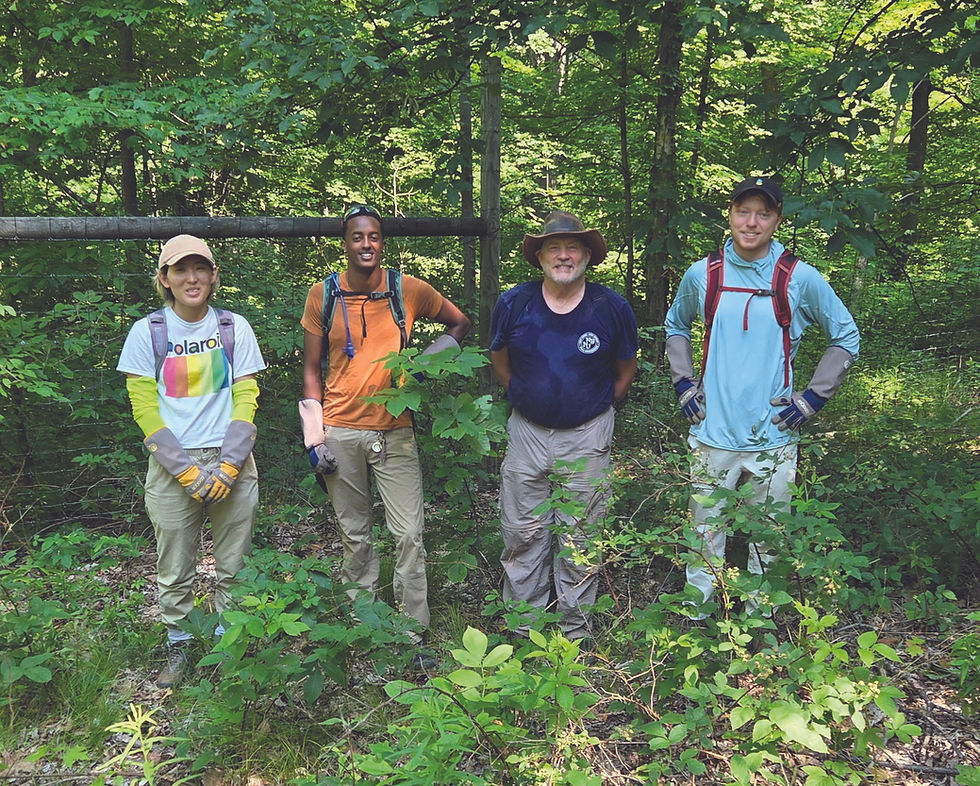
Most students my age spend their summers avoiding heat, dirt and manual labor. My summer revolves around those things. As one of three forest regeneration interns working for the South Mountain Conservancy in the South Mountain Reservation this summer, my days are defined by an ongoing battle against invasive species.
My work takes place in the 14-acre wildflower and wilderness preserve, a fenced enclosure around the dog park designed to keep out deer. To most of the reservation’s visitors, invasive species appear indistinguishable from native plants. Unfortunately, their impact on the ecosystem is greater than meets the eye. Most of the wild spaces in our region are overrun with invasives. These plants crowd out native species that have lived here for thousands of years, plants that have established relationships with other plants, animals, insects and even soil.
My work is important because it gives our native ecosystem a fighting chance to recover and thrive in a space protected from the overbrowsing by white-tailed deer, which elsewhere decimate the reservation’s understory. For this reason, summer internships have been funded by the conservancy since 2014 to supplement its monthly forest regeneration volunteer activities. This year, the program is being overseen by one of the forest regeneration co-program coordinators, Rich Rockwell. (More information at somocon.org.)
Before I started this internship, environmental science was largely a theoretical concept to me. It lived in textbook diagrams, vocabulary lists and multiple-choice tests. Pulling Japanese knotweed, wineberry, mugwort and the notoriously thorny multiflora rose out of the New Jersey soil changed all of that. I am quickly learning that conservation isn’t just a passive love for nature; it is an active, demanding discipline.
Tackling these dense patches requires strategy, stamina and a deep understanding of how local ecosystems function. You cannot just chop away at the surface; you have to understand how each plant spreads and how to safely eradicate it without damaging the surrounding habitat. Seeing the immediate impact of our labor when watching a vine choked tree begin to thrive bridges the gap between classroom theory and real-world application.
Beyond the ecological fieldwork inside the enclosure, our responsibilities extend into community management. We spend afternoons maintaining the preserve’s trail network, clipping back encroaching branches and even poison ivy to ensure hikers can safely enjoy the woods. We also step outside the boundaries of the preserve to tackle projects for the South Mountain Conservancy, such as installing new signage around the reservation.
These tasks teach me that environmental work is inherently tied to public service. It isn’t just about protecting the trees. It’s about managing the relationship between humanity and the natural world. Learning how to communicate conservation efforts to the public ignites my passion for community-focused environmentalism.
As the start of the school year approaches, the lessons I carry out of the woods are coming with me into the classroom. Fieldwork teaches a unique brand of resilience. It helps you contextualize the importance of the problems you face. When you are staring down a dense wall of invasive mugwort or burning bush in the mid-July humidity, you cannot simply quit because you are tired. You have to pace yourself, rely on your team and tackle the problem methodically, one piece at a time. That exact mindset is what I plan to bring to my upcoming academic challenges. The persistence required to clear a trail is the same persistence required to navigate a difficult research paper, to understand lab results or manage a grueling exam schedule.
Ultimately, this ongoing summer experience gives me a gift that standard school semesters rarely can: renewed certainty about my path forward. I no longer view my upcoming classes as just a series of graduation requirements to fulfill. Instead, I see them as the essential toolkit I need to solve the very real environmental challenges I witness firsthand every day. My time at the South Mountain Reservation is transforming an interest in science into a concrete career ambition. I am returning to school with dirty boots, some poison ivy rashes, a few fading scratches and a clear vision of the environmental scientist I want to become.
Henry Donat is a rising senior at Marist University, future environmental consultant and your go-to guy for pointing out ecological hazards you definitely didn’t want to know about.


Comments