


INSPIRING THE NEXT GENERATION OF SCIENTISTS
Columbia High School's Science Research Program connects students and mentors
By Savannah Martin

Columbia High School is known for its dazzling annual musical, its singular Special Dance Program and its claim to fame as the birthplace of Ultimate Frisbee. However, CHS is also home to a lesser known hidden gem: the Science Research Program, a multiyear science elective exposing students to the real world of research.
There is no memorizing formulas or duplicating tired old lab experiments. Instead, the program breaks down the classroom walls altogether as students do a deep dive on a topic of their choosing and work side-by-side with expert research mentors. From amoebas to asteroids, program members have followed their curiosity and passion into research with real meaning and purpose.

Hannah Morris, a student of the program who graduated in 2025, says her love for the environment led her to seek the guidance of a professor at the University of Pennsylvania School of Veterinary Medicine. She studied the effects of human-caused mortality in New Jersey’s bald eagles. “I was interested in local environmental issues because it’s an area where I believe I can have the most impact,” she says.
Her time at her mentor’s veterinary center during a program field visit to observe necropsies, a veterinary pathology procedure, is an example of how Morris says that the Science Research Program put her “right in the middle” of experiences that help make the planet a better place. “My mentor was extremely helpful and knowledgeable and took me seriously as a scientist, which will always mean a lot to me.” Morris hopes to continue this mission by completing her undergraduate degree at University of Pittsburgh in environmental science and building a career in sustainability.
Becoming fluent in the world of science research is an increasingly essential skill. “It’s the world we live in now,” says Anna Torrey, who graduated from CHS in 2018. Torrey went on to complete a molecular and cellular biology pre-medicine degree at The Johns Hopkins University. “I’ve been doing research ever since!” she says.

Knowing how to do data analysis and critically review scientific papers gives CHS students a decisive advantage. “Classmates in college were so overwhelmed by research. In that sense, it put me and my CHS friends ahead.” Torrey is now a third-year medical student at Columbia University of VaIgelos College of Physicians and Surgeons.
A whole generation of CHS students has been shaped by the Science Research Program, which was the original ambition of Allan Tumolillo. Affectionately known as “Mr. T,” he launched the program at CHS in 2014 so “kids could take learning into their own hands and discover what it is they really want to do.” Now retired, Mr. T is especially proud of the opportunities students had for college-level research before they set foot in a college dorm.
The classic apprenticeship model for learning has been a tradition in science research for generations and a way for mentors to inspire younger generations. Dr. Igor Andreoni, assistant professor of physics and astronomy at the University of North Carolina at Chapel Hill, mentored Naomi Lederman and Henry Martin (Class of ‘25) in the use of pioneering techniques to discover star-consuming massive black holes. Andreoni says, “Mentoring is my way to give back. I would have not had many incredible opportunities without the guidance and support from my own mentors.”
Andreoni tries to develop future-thinking science leaders. “I want to help students feel engaged in their projects and help them develop skills towards their long-term goals, either in academia or in industry. I believe that when students work on projects that they feel to be their own, they can enjoy research thoroughly while developing leadership.”
Although some CHS students discover their passion during the course of the program, others bring what began as a childhood fascination and meaningfully deepen it. As a child, Jacob “Jake” Kalodner (Class of ‘17) became captivated by archaeology through books. He participated in an archaeological dig at age 10 while on vacation with his family. The Science Research Program presented the perfect opportunity to pursue his interest in archaeology, a subject not commonly taught in schools.
Mentored by an archeology professor at Yale University, Kalodner worked to analyze a collection of more than 5,000 pieces of ancient Mongolian pottery. “I went up to Yale and collected these materials. The majority of my high school research career was looking at pieces of pottery and recording information.”
Now travelling worldwide as part of his PhD studies in anthropology at Harvard University, Kalodner reflects years later on his time in the program. “A lot of research ideas happen through serendipity. They happen through luck. People who you meet unexpectedly at a conference. People who you had no intention to talk to. Ideas come to you from reading things you weren’t necessarily interested in reading. A lot of it is allowing yourself to be in situations that are conducive to that kind of luck.”

Kalodner learned from his time in Science Research that “being persistent and working hard opens up that door for lucky things to happen. But you also have to work hard. It’s not just luck.”
Kalodner’s hard work was recognized by his research mentor, who supported his application to Yale University, continuing on to University of Cambridge and now Harvard.
Alumni from the program’s early years are already making an impact in the workforce. Sam Forman (Class of ‘18) researched the intersection of cryptography and artificial intelligence, well before these topics were mainstream. He says that the Science Research Program validated his work and “made the research feel real in a way a typical school project does not.” His project was accepted at an academic conference before he went on to study mathematics and computer science at Stanford University. Forman’s risk-taking, innovation and creativity propelled him to take a leave from college to start a tech company, for which he successfully raised $6 million in seed funding.
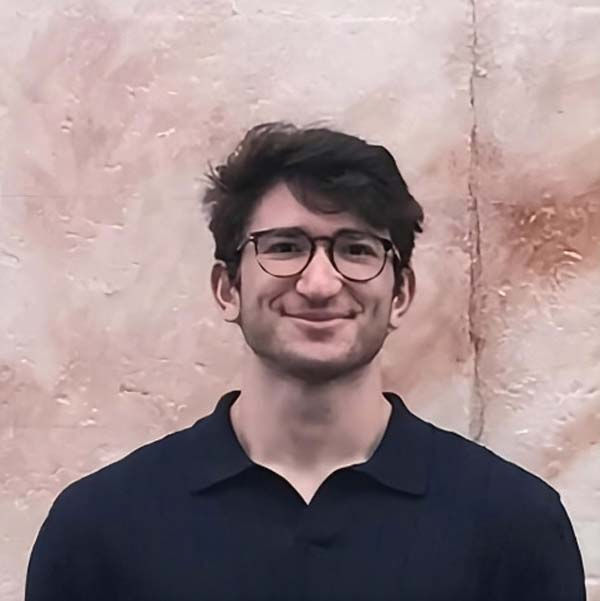
Kathleen Wade, a CHS physics teacher, has led the Science Research Program since 2020. She set out to build a strong culture of collaboration, curiosity and independence, encouraging students to pursue research topics that magnetize them. In addition to PowerPoint presentations, students conduct peer review, which is the process of evaluating a fellow scientist’s research. This fundamental step in the scientific research process also exposes students to new fields.
Science can be present in other disciplines, including the field of art. During her time at CHS, Maia Curran (Class of ‘22) collaborated with art conservationists at Cooper Hewitt Smithsonian Museum. She analyzed age-related degradation in plastic and 3D-printed art objects
Maia Curran completes her undergraduate degree in Women and Gender Studies at Smith College this spring with plans to pursue a law degree.

Sam Forman studied mathematics and computer science at Stanford University.with Sarah Barack and Jessica Walthew, local experts living in SOMA. “I was passionate about my role in a mentorship with two female scientists, particularly in such influential roles in the field,” Curran says. “Science and scientific research tend to be historically male-dominated fields.” She says that major contributions of women are overlooked and that their voices are necessary on the frontlines. Curran’s experiences in the program helped inform her desire to engage in historically marginalized areas. Although she has put down her art for now, she says, “the tools of mentorship remain.”
Our towns have a wealth of resources and experts who give back to their school community. Commenting on her decision to support the program, Barack, a senior conservator for Guggenheim Abu Dhabi, says, “I have always loved working with students, mentoring them and sharing my passion for the ways art and science intersect.” Raising awareness of the intersection serves another important purpose. “With arts funding often receiving budget cuts, I feel it is important to show ways in which applied science in this field can promote and support the arts.” Like other research mentors, Barack says she “enjoys watching students in the act of experimentation, discovery and learning new things.”
Science Research students may not experience the grand applause of a CHS musical on closing night. However, they showcase their findings in impressive venues and university conferences. Many have been published in prestigious academic journals. No small feat for high school students!
Alumni from Wade’s most recent graduating class carry the program’s legacy at Brown, Cornell, Princeton and other top-tier universities. The program continues to give students life-changing opportunities to explore their passion, attain great achievements and make the world a better place.
Savannah Martin is a junior at Columbia High School researching dermal absorption and endocrine disruption in the CHS Science Research Program

Comments