


PRESERVING NEW JERSEY'S FILM LEGACY AND THE MAPLEWOOD THEATER
Updated: Oct 13
Film Society co-founder starts new magazine documenting the filmmaking boom
By Ben Wasserman
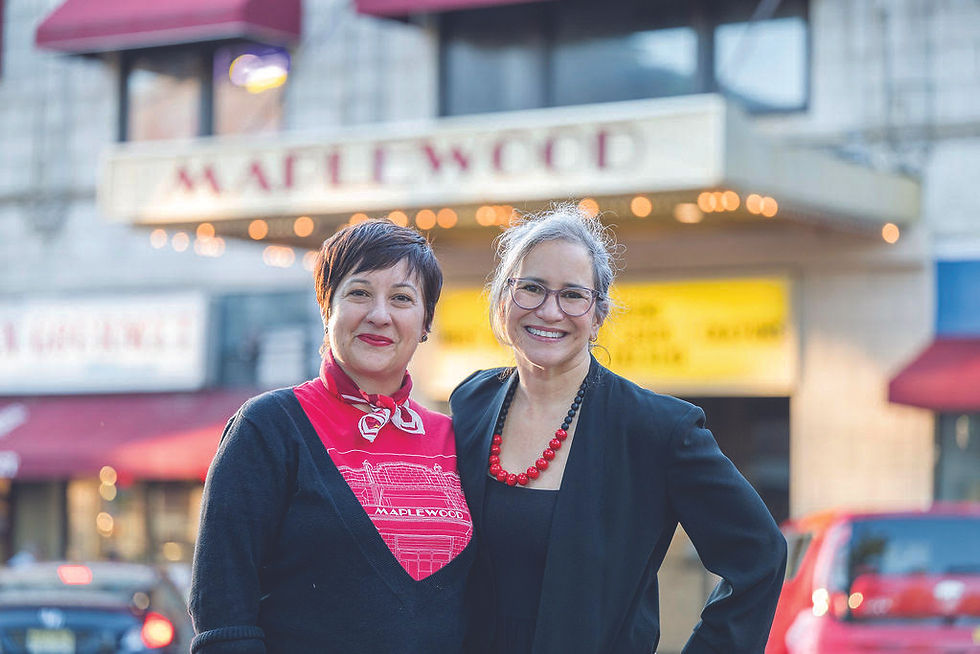
Angela Matusik has lived in Maplewood since 2011, but she still remembers the first movie she saw in town.
“They were showing Star Wars in the park,” Matusik, a co-founder of the Maplewood Film Society, says over Zoom, recalling the impact Princess Leia Organa had on her daughter. “Our kid was like 2 and a half, and I remember afterwards she said that she liked the lady with the big ears, which is what she called hair.”
For Matusik, her personal and professional endeavors tie back to the film industry and its relationship with her town and state. This coincides with New Jersey’s growing involvement in film and television productions, earning the nickname “Hollywood East” during a moment of great uncertainty for the industry’s future. Connecting these threads is her ongoing mission to preserve an icon of the SOMA area on the eve of its 100th anniversary.

A journalist and former head of corporate brand for HP, Matusik has always been drawn to the world of cinema. In her early career, she worked for pop culture and fashion outlets such as InStyle and People, keeping an independent blog on the side to cover breaking media developments. Even after leaving HP to start her consulting business, A.M. Stories, the entertainment industry remained a big part of Matusik’s clientele. But when her family moved from New York City to Maplewood, a big selling point wasn’t just the easy commute. Their house happened to be walking distance from the historic Maplewood Theater.
For generations of residents, the theater has been a signature of the downtown Maplewood Village. Now on the verge of its 100th anniversary, the theater, which was designed by New Jersey architect William E. Lehman in 1927, remained active for 92 years before closing amid COVID-19. Afterward, theater owner Vinnie Loffredo – whose family also runs the next-door pizzeria Roman Gourmet – initially considered selling the place, and a redevelopment plan was announced. This news caught the attention of Matusik who, along with her friend Lisa Cohen, identified a need to preserve the theater.

“We heard about this redevelopment plan, and we knew that a lot of people like us just weren’t paying close attention to local politics and all the legislation that was being passed,” she says. This led Matusik and Cohen to create the Maplewood Film Society, a nonprofit dedicated to “creating one-of-kind cinematic experiences” by hosting film screenings across the SOMA area, with the long-term goal of converting the Maplewood Theater into an independent cinema.
These screenings occur periodically, due to the lack of a consistent venue. Each event provides the opportunity for conversations about the film industry that coincide with new releases or the loss of key industry figures. A 2025 screening of Wild at Heart at The Woodland took place shortly after director David Lynch’s death, featuring a Q&A with Lynch’s cinematographer Frederick Elmes. Princeton African American Studies professor and South Orange resident Khalil Gibran Muhammad was invited to talk about Ryan Coogler’s Sinners. A month later, the movie took home four Oscar wins.
Most recently, the Maplewood Film Society hosted an exclusive SOPAC screening of Summer of Soul, a 2021 Hulu documentary about the historic-yet-forgotten 1969 Harlem Cultural Festival. Analyzing the festival’s cultural significance and why it’s been lost to time within counterculture memory compared to Woodstock, the movie received widespread acclaim and won an Oscar for Best Documentary Feature. The screening was made possible in part by society board member Alison Dinerstein, whose husband David produced Summer of Soul and joined the event as a post-screening guest.
Progress has been made on preserving the downtown theater. On Jan. 6, the Loffredo family signed a lease with James Kula of Box Office Cinemas to renovate the theater within a six- to 12-month timeframe, with Matusik attending the ribbon-cutting ceremony. (She and Cohen also participated as interview subjects for a middle school documentary about the Maplewood Theater’s legacy.) Loffredo says the theater is currently being cleared out but remains a work in progress.
“It’s going to take time. [Kula’s] in the process of getting permits and construction and architects. It’s a long process, but it’s going to be beautiful,” Loffredo says.
That love of cinema also played a role in Matusik’s newest business venture, one that shines an investigative light on the film production resurgence happening in New Jersey.
The idea for SOCKO! Magazine came to Matusik last year while reading about Netflix buying part of Fort Monmouth for $55 million, aiming to transform the U.S. Army base into a massive East Coast production complex. Netflix broke ground on the studio in May, with the intended goal of converting this land into backlots, soundstages and office space by 2028.
Historically, U.S. cinema began in New Jersey, with Thomas Edison constructing the first film studio, the Black Maria, at his West Orange laboratory. The earliest film serials were shot in Fort Lee, including The Perils of Pauline featuring silent actress Pearl White whose success coined the term “cliffhanger.” Yet it was Edison’s belligerent enforcement of camera patents that caused other filmmakers to flee west, where they settled in Hollywood and turned it into the new center of the American film industry.
During the past century, New Jersey has been used as a setting for plenty of iconic stories, from On the Waterfront to Clerks and The Sopranos. Some movies, such as South Orange native Zack Braff’s Garden State and A Good Person, as well as Netflix’s Happy Gilmore 2, were partially filmed in the SOMA area. But only in recent years has the state’s involvement in film and television production grown exponentially. In 2018, former governor Phil Murphy reinstated 30-35% tax credits on qualifying film productions, incentivizing more studios to set up shop in the Garden State and support local workers. This credit program has since been extended to 2049.
The process, so far, has paid dividends. A combination of tax credits, close proximity to New York City and initiatives like the Film Ready New Jersey Program have endeared many studios to the benefits New Jersey offers, with notable movies shot in-state including Disclosure Day, The Housemaid, A Complete Unknown, and I Play Rocky. Alongside Netflix’s studio plans, Lionsgate is setting up Great Point Studios in Newark, while Paramount is sponsoring 1888 Studios in Bayonne. This marks a new chapter for the state’s role within the entertainment industry, opening doors for a lot more film talent who see New Jersey as their home.
Matusik took notice of these developments and decided to cover them. “I just saw all these great stories unfolding around me. And because of my past experience, I was like, ‘Okay, now this is a really good idea, and we have to make it happen now,’ ” she says.
To get a full picture of New Jersey’s film scene, she reached out to Adam Nelson, CEO of Workhouse PR, professor at the New Jersey Film Academy, and author who resides in Long Branch. Nelson had film industry contacts. They pooled their resources into a magazine dedicated to covering these statewide developments and spotlighting underrepresented film talents who live locally, including actors, graphic designers, sound engineers and composers.
SOCKO! Magazine launched this spring at the New Jersey Film Expo held in East Rutherford. It currently has more than 5,000 subscribers and won Best eMagazine at the 2026 dotCOMM Awards. According to Matusik, they are now in a fundraising phase and looking for editorial and sales talent, though a fall issue is expected to come out sometime in October or November. Some notable SOCKO! interviews with industry veterans – currently available to read online – include When Harry Met Sally production designer Jane Musky (born in Maplewood) and Monk actor Tony Shalhoub.
The story in which Matusik took the most pride, however, involves Cedar Grove resident Michael Uslan, chairman of the New Jersey Motion Picture & Television Commission. Uslan’s accomplishments are legendary among superhero fans. He taught courses on the history of comic books at Indiana University in the 1970s. As a young man, he bought the film rights to Batman, resulting in Uslan being listed as a producer on every Batman film since Tim Burton’s 1989 blockbuster.
Even more important, Matusik added, was how Uslan’s story reflects the business ingenuity of an average New Jersey resident. “I think in some ways it really captures the essence of what we’re all about and what the state is about as well,” she says.
Building this magazine combines skills from all of Matusik’s past experiences, including her brand consultant job. But it’s the commitment to storytelling, as well as understanding this homegrown pipeline between New Jersey communities and cinema that drives her passion for the Maplewood Film Society and SOCKO! Magazine. She is also heartened by the number of women taking initiative and starting their own businesses without waiting for permission.
“The best thing is to get out of your house and go to a conference or a panel now and then and hear other people speak in real life,” Matusik offers as advice to these aspiring entrepreneurs. “I think it’s really important to continue to broaden your eyes and have an open mind about how you do things and know that you can always learn something new.”
Ben Wasserman is a freelance writer and Rotten Tomatoes-certified film critic with more than a decade of experience covering the entertainment industry.


Comments